 English
  Español
 Italiano
 Français 🤖
 Português 🤖
 Deutsch 🤖
 Ελληνικά 🤖
 Esperanto 🤖
 العربية 🤖
 हिन्दी 🤖
 Indonesia 🤖
 日本語 🤖
日本語 🤖 Русский 🤖
 Türkçe 🤖
 简体中文 🤖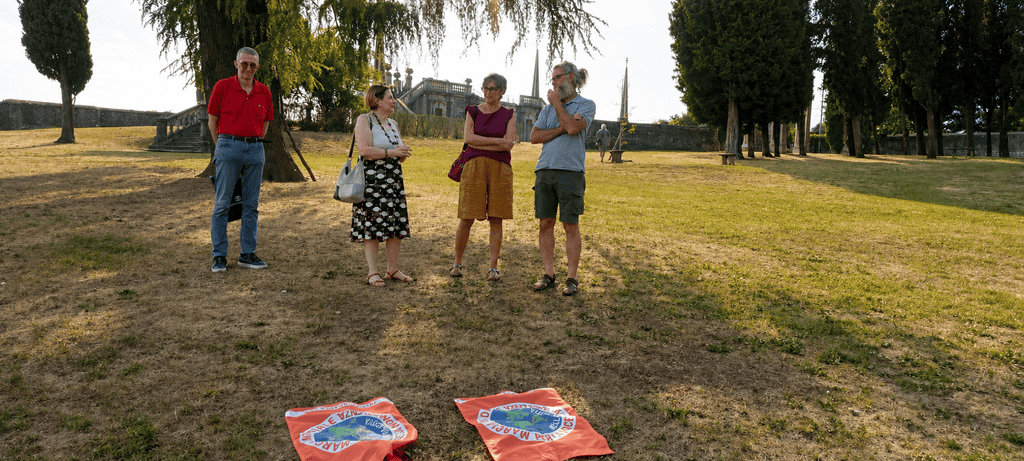
A meeting dedicated to Hiroshima and Nagasaki reflects the spirit of the 4th World March for Peace and Nonviolence in my city
Comerio, a small town in the province of Varese, hosted a meeting on August 7 dedicated to Hiroshima and Nagasaki, 81 years after the atomic bombings. In the park of Villa Tatti Talacchini, a late-Baroque residence built at the beginning of the 18th century, whose garden still preserves its historic Italian-style layout, a simple and intimate gathering took place, born from the desire to keep alive the memory of the victims and, at the same time, to reflect on the present, marked by wars, rearmament and the persistent threat of nuclear weapons. The choice of this location gave the meeting a special meaning. The park is home to a Nagasaki kaki tree, grown from the seeds of one of the trees that survived the atomic explosion of August 9, 1945. In autumn, Villa Tatti will also welcome a Hibakujumoku from Hiroshima, a young tree descended from one of the plants that survived the bombing of August 6, 1945. The memory of Hiroshima and Nagasaki thus becomes something concrete and alive: trees that continue to grow and that can convey a message of resilience, hope and responsibility to new generations. During the meeting, “After the Rain” by Gianni Rodari (writer and pedagogue) was also read. Rodari, a writer and educator, spent his formative years in nearby Gavirate. His words accompanied the reflection with a simple image of hope and rebirth, in harmony with the message conveyed by the trees that survived the atomic bomb.
The Comerio meeting is a concrete example of the spirit of the 4th World March for Peace and Nonviolence, which in this fourth edition proposes a new perspective: “The World March in my city.” After three editions in which a base team travelled across the five continents, the proposal today is to bring the March into territories, cities, towns and neighbourhoods. Not to leave, but to stay.
Not to move away, but to connect. Not to delegate, but to participate. The aim is to ensure that local initiatives are not isolated events, but can create relationships and practices capable of continuing over time, helping to build permanent local spaces for peace and nonviolence.
The central period of the Fourth March will run from September 21, International Day of Peace, to October 4, 2026, including October 2, International Day of Nonviolence. But the new approach does not end on these dates: initiatives can begin beforehand and continue afterwards, giving continuity to the process. Comerio is also moving in this direction. Around mid-October, another meeting connected to the World March is planned at Villa Tatti Talacchini, after the official period of the March, but specifically intended to continue the journey and keep alive the connections built in the local community. The Fourth March is already looking to the future. The perspective for the 5th World March in 2027 is to further expand the network of participating cities, with the goal of reaching 1,000 cities. An important step will be the European Continental Symposium, scheduled to take place in Spain in early January 2027, as an opportunity to discuss and evaluate the experience of the Fourth March and reflect on the prospects for the next stage of the process.
The challenge is therefore to transform the many local experiences into an increasingly strong network, capable of growing over time. And Comerio, with its small territory, can be one piece of this mosaic.
Image by Vittore Ciotti