
 English
  Español
 Italiano
 Français 🤖
 Português 🤖
 Deutsch 🤖
 Ελληνικά 🤖
 Esperanto 🤖
 العربية 🤖
 हिन्दी 🤖
 Indonesia 🤖
 日本語 🤖
日本語 🤖 Русский 🤖
 Türkçe 🤖
 简体中文 🤖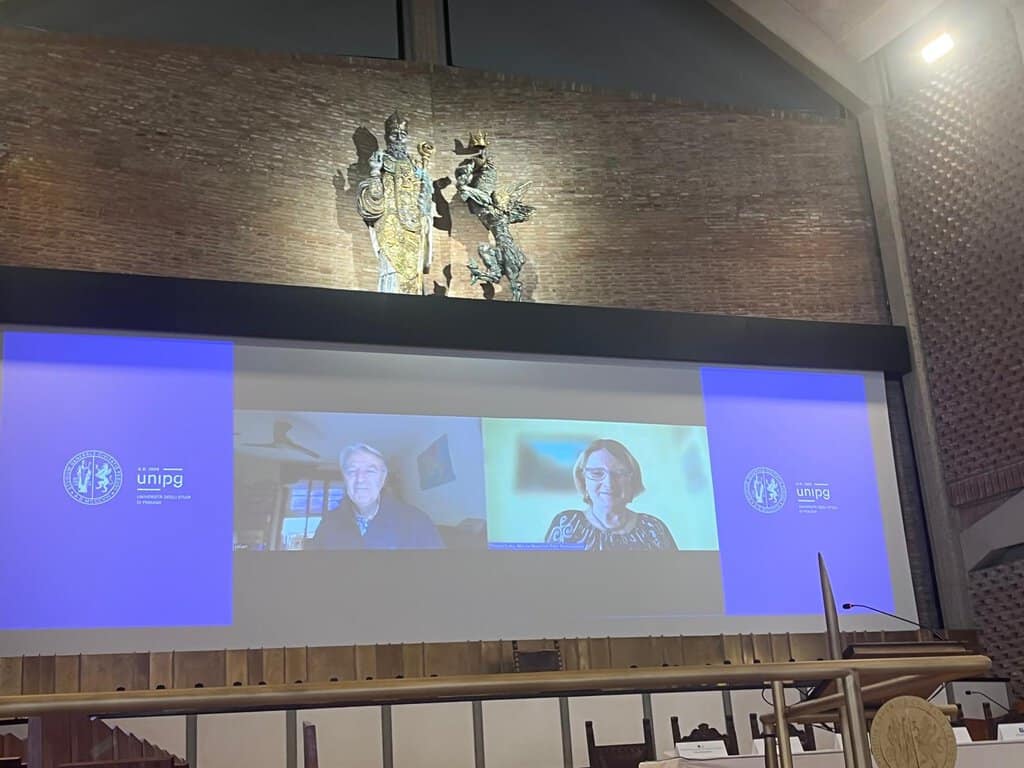
Following the “Paths to Peace” meeting held on 19 November 2024, marked by the active participation of the students of UniPg for Peace, the journey launched at the University of Perugia has continued through opportunities for reflection and concrete initiatives.
At the heart of this journey lies the Assisi Charter, which promotes the university as a place of dialogue, encounter among differences, and education for peace. During the discussion involving Rafael de la Rubia, promoter of the World March for Peace and Nonviolence; Rector Massimiliano Marianelli; Professor Daniele Parbuono, Rector’s Delegate for Peace Policies; and Professor Elisa Delvecchio, Co-Delegate for Peace Policies, the need emerged to strengthen the university’s role as a space of responsibility, participation, and the promotion of a culture of nonviolence.
This journey reached a new milestone on 12 May 2026 with the event “Building Peace. The Space of the ‘In-Between’ as a Place of Thought, Word, and Action,” which brought together institutional representatives, scholars, and students to reflect on the university’s role as a common good and as a place where practices of peace are developed.
These reflections were accompanied by concrete actions. Through the Document for Peace in Palestine and the Protection of Human Rights, the University of Perugia affirmed that every scientific and academic cooperation agreement must be consistent with respect for human rights, peace, and justice. For this reason, the University declared that it will neither establish nor renew agreements with universities, institutions, companies, or other organisations directly or indirectly involved in serious human rights violations or in the arms industry.
To put these principles into practice, the University also established a Monitoring Observatory on the University’s Agreements Concerning Conflict Areas, tasked with assessing whether academic collaborations are consistent with the guidelines adopted by the Academic Senate.
Within this context, the event “The Courage to Say No. Franco Rasetti, Science, and Ethics,” organised by the Department of Physics and Geology on 16 June 2026, also finds its place.
The figure of Franco Rasetti represents a particularly significant point of reference. One of the leading members of the Via Panisperna boys and among the foremost Italian physicists of the twentieth century, Rasetti chose not to participate in the development of military applications of nuclear research. His “no” was not a rejection of science but rather an affirmation of the ethical responsibility that must accompany knowledge and its applications.
For this reason, the event was symbolically linked to the reading of Salvatore Puledda’s Ethical Commitment, which calls upon researchers, educators, and professionals to use their knowledge exclusively for the benefit of humanity and never to oppress or destroy. It is an appeal to place science, education, and research at the service of human dignity, dialogue, and nonviolence.
The path undertaken by the University of Perugia thus demonstrates that peace is not merely a subject for discussion, but a guiding principle capable of shaping cultural, academic, and institutional choices. It is a challenge that involves the entire university community and finds two highly relevant points of reference in Rasetti’s example and in Puledda’s words.